
How Malawi’s women built a national team, how the Chaŵinga sisters changed its ceiling, and how a generation finally broke through
Before Brazil, there was Harare.
Before WAFCON, there was COSAFA.
Before Tabitha Chaŵinga was playing Champions League football in Europe, before Temwa Chaŵinga was breaking scoring records in the United States, and before Faith Chinzimu scored the goals that finally carried Malawi into the Women’s Africa Cup of Nations, there was a national team trying to establish itself in African football.
The Malawi Women’s National Football Team played its first recorded senior international in April 2002, losing 8–0 to Zambia in Harare. The Football Association of Malawi records that match as the beginning of the Scorchers’ senior international history. (fam.mw)
More than two decades later, the same country would beat Nigeria at its first WAFCON, qualify for its first senior FIFA World Cup and reach the continental final.
That journey was not linear.
There were years when Malawi barely registered in conversations about the strongest women’s teams in Africa.
There were failed qualifying campaigns.
Regional tournaments that ended in the group stage.
A first COSAFA semi-final.
A first COSAFA final.
A final lost.
A title finally won.
A generation of world-class talent playing abroad while the national team remained outside Africa’s premier competition.
And then, almost suddenly to those who had not been paying attention, everything began to converge.
The story of the modern Scorchers is partly the story of Tabitha and Temwa Chaŵinga.
But it is also the story of Sabinah Thom, Madyina Nguluwe, Chimwemwe Madise, Asimenye Simwaka, Mercy Sikelo, Rose Kadzere, Faith Chinzimu, Lovemore Fazili and a growing group of players who turned individual possibility into national progress.
The Chaŵingas raised the ceiling.
The Scorchers built the team underneath it.
And in 2026, those two stories finally met.
The early years
Malawi entered senior women’s international football in 2002, during the same period in which the COSAFA Women’s Championship was beginning to create a more regular competitive structure for women’s national teams in southern Africa. FAM records Malawi’s first international as the 8–0 defeat to Zambia on 20 April 2002.
The early decades were difficult.
Unlike the continent’s established powers, Malawi did not have a long history at the Women’s Africa Cup of Nations.
The Scorchers did not qualify for the continental championship at all before 2026.
Regional football therefore became enormously important.
COSAFA was where Malawi could repeatedly measure itself against South Africa, Zambia, Zimbabwe, Botswana and the rest of southern Africa.
For years, those tournaments provided evidence of potential without delivering a breakthrough.
As recently as the five tournaments from 2017 through 2021, Malawi’s finishes traced a gradual progression:
2017 — group stage
2018 — group stage
2019 — group stage
2020 — semi-finals
2021 — runners-up.
That sequence tells much of the story.
The Scorchers were not suddenly created in 2023.
They were climbing.
Then came the Chaŵingas
By the late 2010s and early 2020s, Malawi had something it had never possessed at this level before:
two players simultaneously establishing themselves as genuine international stars.
Tabitha Chaŵinga had gone first.
Her career took her from Malawi into Sweden and then China, eventually continuing through Italy and France.
Temwa followed part of the same route through Sweden and China.
By 2020, both were playing professionally abroad, and FIFA was already describing them as the Malawian sisters “lighting up China.”
Their club careers created an unusual situation.
Malawi still had not qualified for WAFCON.
Yet the national team possessed two forwards who were succeeding at levels far beyond the international standing of the team itself.
The country’s footballing infrastructure and its greatest individual talent were developing at different speeds.
That tension would define the next several years.
2020: a warning of what might be coming
The 2020 COSAFA Women’s Championship offered one of the first glimpses of what Malawi could become when the sisters were together.
Against Lesotho, Malawi won 9–0.
Tabitha scored six goals.
Temwa scored another.
Asimenye Simwaka and Zainab Kapanda also found the net.
Tabitha finished the tournament with seven goals, joint-top of the scoring charts, while Temwa scored three.
But perhaps the more important match came against Zambia.
Malawi won 1–0.
Temwa scored the goal. FAM’s tournament record shows a side that already contained several names that would still matter six years later: Chimwemwe Madise, Madyina Nguluwe, Sabinah Thom, Asimenye Simwaka, Tabitha and Temwa Chaŵinga, with Mercy Sikelo also part of the squad.
That continuity matters.
The 2026 team did not materialise overnight.
Some of its foundations had already been playing together years earlier.
Malawi reached the semi-finals in 2020 before losing 6–2 to South Africa.
Temwa scored.
Tabitha scored.
It was not enough.
But a pattern had begun.
Malawi could score against serious teams.
What it could not yet do consistently was survive them.
2021: the first final
The following year brought another step.
Malawi reached the COSAFA Women’s Championship final for the first time.
The route was particularly significant because the Scorchers eliminated hosts South Africa 3–2 in the semi-final.
Sabinah Thom scored twice.
That matters in the history of the team because the breakthrough did not depend solely on one of the Chaŵingas.
Thom became one of the recurring figures in the Scorchers’ rise: a forward capable of producing decisive goals in major regional matches.
Malawi eventually lost the final 1–0 to Tanzania.
The trophy had escaped.
But another barrier had fallen.
Malawi now knew what a final felt like.
The WAFCON wall
Regional improvement did not immediately translate into continental qualification.
Later in 2021, Malawi faced Zambia in qualifying for the 2022 Women’s Africa Cup of Nations.
The first leg in Lilongwe ended 1–1, with Sabinah Thom equalising for Malawi in the 66th minute.
There was an important complication.
Neither Tabitha nor Temwa was available for that first leg because of club commitments in China. Zambia likewise lacked Barbra Banda.
The episode illustrates one of the recurring challenges faced by an emerging national team whose leading players were increasingly employed abroad.
The Chaŵingas could transform Malawi when available.
But the programme also had to become capable of existing beyond them.
Malawi did not reach the 2022 WAFCON.
The continental door remained closed.
2022: another reminder that progress is not linear
At the 2022 COSAFA Women’s Championship, Malawi returned as the previous year’s runners-up.
Expectations had changed.
The outcome did not.
The Scorchers exited at the group stage. COSAFA’s record shows Malawi moving from a 2020 semi-final to a 2021 final and then back to the group stage in 2022.
That is the reality of building a national team.
Progress rarely moves neatly upward.
A breakthrough does not permanently eliminate structural weakness.
Malawi were improving.
But they had not yet become inevitable.
2023: the year everything changed
Then came the tournament that changed the psychology of Malawian women’s football.
The 2023 COSAFA Women’s Championship.
Lovemore Fazili was in charge.
Temwa Chaŵinga was captain.
And Malawi won every match.
They started against hosts South Africa.
Malawi 4–3 South Africa.
Then:
Malawi 8–0 Eswatini.
Temwa scored four second-half goals against Eswatini, having already begun the tournament with a hat-trick against South Africa.
Malawi then beat Madagascar 3–1.
Three group matches.
Three wins.
Temwa’s tournament
Temwa entered that competition already established as one of Malawi’s greatest footballers.
She left it as the face of the country’s first major senior women’s international title.
She scored nine goals.
She won the Golden Boot.
She was named Player of the Tournament.
But Fazili’s use of her is also instructive.
FAM’s own post-tournament analysis highlighted a tactical decision to use Sabinah Thom as the primary striker while Temwa operated in support, allowing Temwa to influence the game beyond simply staying highest up the pitch.
That is an important distinction.
Temwa was the superstar.
She was not the entire system.
Mozambique: Temwa drags Malawi into the final
Malawi faced Mozambique in the semi-final.
They fell behind.
Then Temwa scored twice late.
Malawi 2–1 Mozambique.
Another final.
But this time, Malawi had no intention of merely celebrating getting there.
Zambia again
The final opponent was Zambia.
That rivalry runs through almost every era of the Scorchers story.
Zambia had inflicted Malawi’s first recorded international defeat in 2002.
Zambia had stood between Malawi and WAFCON qualification.
Now they stood between Malawi and its first COSAFA title.
Asimenye Simwaka gave Malawi the lead.
Zambia equalised late through an Agness Phiri penalty.
The match appeared to be heading for penalties.
Then:
Sabinah Thom.
In stoppage time, Thom scored the winner.
Malawi 2–1 Zambia.
Champions.
It was a wonderfully collective ending.
Temwa had dominated the tournament.
But Asimenye Simwaka scored in the final.
Sabinah Thom won it.
And Madyina Nguluwe was named Player of the Match in the final, recognition of the midfield work underpinning Malawi’s attacking talent.
For the first time, the Scorchers had a trophy.
Lovemore Fazili
The coach deserves his own place in the story.
Fazili is a former Malawi men’s international who previously worked with Malawi’s men’s under-20, under-23 and senior sides before moving into the women’s programme. CAF credits him with a significant role in the recent development of the Scorchers.
The 2023 COSAFA title changed the scale of his tenure.
Malawi won all five matches in open play.
Fazili later described ambitions that, at the time, remained aspirational:
WAFCON.
The World Cup.
Greater international competition.
Three years later, those ambitions no longer read like dreams.
The team begins to outgrow the sisters
This may be the most important phase in the Scorchers’ development.
For years, Malawi’s international identity had been inseparable from the Chaŵingas.
That was understandable.
Tabitha and Temwa were operating at a level few Malawian footballers had ever reached.
But a national team cannot sustainably depend on two people.
The evidence that Malawi was becoming something larger began appearing underneath them.
Sabinah Thom had already been the two-goal hero against South Africa in the 2021 COSAFA semi-final and the title-winning goalscorer in 2023.
Asimenye Simwaka scored in the 2023 final.
Madyina Nguluwe became one of the midfield anchors and was Player of the Match in that final.
Chimwemwe Madise had been part of the national setup as far back as the 2020 COSAFA run and remained part of Malawi’s defensive structure six years later.
And beneath the senior team, something even more interesting was happening.
A younger generation was arriving.
Faith Chinzimu and Rose Kadzere
In 2022, Malawi’s under-17 side offered a preview.
Faith Chinzimu, then 15, scored seven goals in four matches at the COSAFA U17 Women’s Championship.
That included four goals in 33 minutes against Namibia and a hat-trick against Botswana.
Rose Kadzere scored eight in the same tournament.
That detail looks much more significant in retrospect.
The national-team pipeline was beginning to produce attackers who did not carry the surname Chaŵinga.
Faith made her senior debut in August 2023 at 16.
She later joined Sweden’s BK Häcken.
The symmetry is striking.
The Chaŵingas had used Sweden as one of their first major international development environments.
Now a teenager from the next Malawian generation was following a similar route.
But Faith’s defining national-team contribution would come at home.
The night Malawi finally qualified
Malawi’s road to the 2026 WAFCON eventually came down to Angola.
Congo’s withdrawal gave Malawi passage through the first qualifying round.
Against Angola in the second round, the away leg finished 0–0.
The return match in Lilongwe remained goalless deep into the second half.
Malawi had spent more than two decades trying to reach WAFCON.
The Chaŵinga sisters had become global stars.
The team had reached COSAFA finals.
It had won COSAFA.
And still the continental tournament had remained beyond reach.
Then Faith Chinzimu scored.
82nd minute.
Then she scored again.
CAF records the second in the 84th minute.
Two goals.
Two minutes apart.
Malawi 2–0 Angola.
For the first time in history, the Scorchers were going to WAFCON.
And there was something deeply important about who had done it.
Not Tabitha.
Not Temwa.
Faith.
The pathway had produced another decisive player.
The sisters’ greatest contribution may not be their goals
Faith has spoken explicitly about what playing alongside Tabitha and Temwa means to the younger generation.
She says the sisters teach discipline, hard work and self-belief, and demonstrate that a player from Malawi can reach the top of the global game.
That may ultimately be as significant as anything in the sisters’ statistical record.
Tabitha’s role has been proof of pathway.
She went first.
She became the first Malawian woman to build a significant professional career in Europe.
Her success created a reference point that had not existed before.
Temwa’s role has been proof of ceiling.
She followed part of Tabitha’s route and then became an NWSL record-breaker, back-to-back MVP, back-to-back Golden Boot winner and one of the most feared forwards in world football.
Together they changed the answer to a basic question for a young Malawian player:
How far can this go?
Before them, the answer was theoretical.
After them, there were addresses.
Sweden.
China.
Italy.
France.
Kansas City.
The Champions League.
The Ballon d’Or.
And eventually:
Brazil.
2026: Malawi arrive ranked 153rd
When Malawi arrived in Morocco for WAFCON 2026, CAF listed the Scorchers at 153rd in the FIFA world ranking and 32nd in Africa.
They were debutants.
Their group contained Nigeria, Zambia and Egypt.
Nigeria were the defending champions.
Zambia had far greater recent major-tournament experience.
Malawi had never played a WAFCON match.
What happened next has already become Malawian football history.
Nigeria: the sisters introduce Malawi
Malawi’s first WAFCON opponent was Nigeria.
Ten-time champions.
Defending champions.
Temwa scored Malawi’s first-ever WAFCON goal in the 73rd minute.
Six minutes later, Tabitha scored.
Then Temwa scored again in stoppage time.
Nigeria 2–3 Malawi.
CAF confirmed another historic detail: Tabitha and Temwa became the first siblings to score in the same WAFCON match.
It could hardly have been scripted more neatly.
After years in which the sisters represented Malawi individually around the football world, they had announced Malawi collectively to Africa.
But the next game again widened the story.
Egypt: Kadzere and Faith step forward
Against Egypt, Rose Kadzere opened the scoring.
Faith Chinzimu scored the second.
Then Malawi went down to ten players when Rose Alufandika was sent off.
Temwa scored the third anyway.
Malawi 3–1 Egypt.
The goalscorers told the story of the programme:
Kadzere.
Chinzimu.
Chaŵinga.
The next generation and the global superstar operating together.
Zambia: Tabitha understands the moment
The final group game against Zambia became one of the strangest matches of Malawi’s tournament.
Zambia led 2–0.
With Nigeria simultaneously beating Egypt, Malawi, Nigeria and Zambia were heading toward a three-way tie on six points.
Malawi did not necessarily need to draw.
They needed one goal to change the head-to-head calculations.
Tabitha scored.
2–1.
Malawi still lost the match.
Malawi still finished top of Group C.
The captain’s goal did not win the game.
It helped win the group.
Ghana: the goal that proves this is no longer only their team
The quarter-final against Ghana carried the biggest stakes yet.
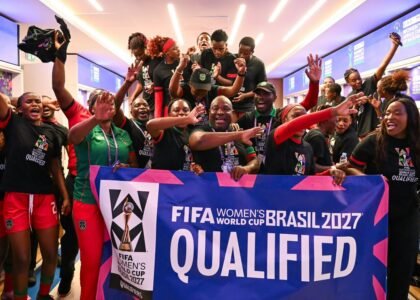
Win, and Malawi would qualify for the 2027 FIFA Women’s World Cup.
Ghana scored in the seventh minute.
Temwa equalised five minutes later.
Then, in the 79th minute:
Rose Kadzere.
Malawi 2–1 Ghana.
World Cup.
If one moment captures the evolution of the Scorchers, it may be that goal.
The Chaŵingas had spent years opening doors.
Temwa had brought Malawi level.
But the goal that actually carried the country through the World Cup door came from one of the players following behind them.
Rose Kadzere sent Malawi to Brazil.
That is what a pathway looks like when it begins becoming a system.
Mercy Sikelo: the other end of the pitch
Attacking players naturally dominate Malawi’s story.
But this WAFCON run would not exist without Mercy Sikelo.
Through the semi-final, Sikelo had made 19 saves:
six against Nigeria;
four against Egypt;
one against Zambia;
one against Ghana;
and seven against Algeria.
She has not built her tournament around clean sheets.
Malawi had conceded in every game through the semi-final.
Her contribution has instead been about keeping games alive long enough for Malawi’s attacking quality to decide them.
The semi-final against Algeria was the clearest example.
Algeria: the sisters take Malawi to the final
Algeria generated 23 shots.
Mercy Sikelo made seven saves.
At the other end:
Tabitha scored.
Temwa scored.
Tabitha scored again.
Algeria 1–3 Malawi.
The sisters scored all three.
Malawi reached the WAFCON final.
On debut.
Through five tournament matches, Tabitha had scored four goals.
Temwa had scored five.
Together:
nine of Malawi’s 12 goals.
There is no honest telling of this tournament that diminishes their dominance.
But there is also no honest telling that stops with them.
The women around the sisters
The modern Scorchers are compelling precisely because the supporting cast has become too consequential to call a supporting cast.
Sabinah Thom — the breakthrough scorer
Two goals against South Africa in the 2021 COSAFA semi-final.
The stoppage-time winner in the 2023 COSAFA final.
Thom helped turn Malawi from a regional participant into a finalist and then a champion.
Madyina Nguluwe — the midfield continuity
Part of the 2020 COSAFA squad.
Still central to the team years later.
Player of the Match in the 2023 COSAFA final.
Asimenye Simwaka — the final scorer
Another player with roots in the earlier Scorchers generation.
She scored Malawi’s opening goal in the 2023 COSAFA final before Thom won it late.
Chimwemwe Madise — the defensive bridge
Madise appears in Malawi’s 2020 tournament records and remains part of the defensive core at WAFCON 2026.
Faith Chinzimu — the door-opener
Seven goals at the 2022 COSAFA U17 tournament.
Senior debut at 16.
Two late goals against Angola.
The player who finally took Malawi to WAFCON.
Rose Kadzere — the next generation
Eight goals at the same U17 tournament in which Faith scored seven.
A WAFCON goal against Egypt.
And then the biggest one:
the winner against Ghana that took Malawi to Brazil.
Mercy Sikelo — the last line
Part of the Scorchers setup as far back as 2020.
Nineteen saves through Malawi’s first five WAFCON matches.
Seven in the semi-final alone.
Lovemore Fazili — the continuity on the touchline
The coach who delivered Malawi’s first COSAFA title.
Then its first WAFCON qualification.
Then its first senior FIFA World Cup qualification.
Then its first WAFCON final.
That is not a miracle assembled in three weeks.
It is accumulated work becoming visible all at once.
So what exactly did the Chaŵinga sisters change?
The easiest answer is goals.
And there have been many.
But that answer is incomplete.
Tabitha changed the imagined geography of Malawian women’s football.
A girl from Malawi could play in Sweden.
Then China.
Then Italy.
Then Paris.
Then Lyon.
A Malawian could play Champions League football and stand among the Ballon d’Or nominees.
Temwa extended that geography again.
China.
Kansas City.
NWSL records.
MVP.
Golden Boot.
Ballon d’Or.
Their careers turned distant football institutions into conceivable destinations.
Then they brought that experience back into the national team.
Tabitha now carries the captaincy.
Temwa has repeatedly supplied decisive goals.
At WAFCON they have functioned as the attack’s gravitational centre.
Opponents have to account for them.
That attention creates space for everyone else.
But perhaps their greatest contribution has been cultural.
Younger players no longer need to imagine what an elite Malawian football career might look like.
They can look across the dressing room.
Faith Chinzimu has described precisely that effect: the sisters show younger players that being from Malawi does not prevent them from reaching the top.
That is legacy happening before retirement.
And what did the Scorchers give the sisters?
The relationship runs both ways.
For all their club success, there was something Tabitha and Temwa could not achieve alone.
They could not take Malawi to a World Cup without a national team capable of going with them.
For years, their résumés were much larger than Malawi’s international résumé.
Now those stories have caught up with one another.
Tabitha can be a Ballon d’Or nominee and captain a World Cup-bound Malawi.
Temwa can be an NWSL MVP and score the goal that brings Malawi back into a World Cup quarter-final.
The sisters gave the Scorchers global possibility.
The Scorchers have now given the sisters something their club careers never could:
Malawi at a FIFA World Cup.
From 8–0 to Brazil
There is an extraordinary symmetry in the national-team timeline.
Malawi’s first recorded senior international:
Zambia 8–0 Malawi.
Harare.
Twenty-one years later:
Malawi 2–1 Zambia.
COSAFA final.
Champions.
Three years after that:
Malawi lose 2–1 to Zambia and still win their first-ever WAFCON group.
Then beat Ghana.
Then beat Algeria.
Then qualify for Brazil.
The opponent that once represented the scale of the gap became one of the recurring measuring sticks of Malawi’s progress.
That is what two decades of football development looks like when compressed into scorelines.
The Scorchers are no longer an exception story
There is a tempting way to tell this history:
Malawi somehow produced two miraculous sisters.
The sisters became world-class.
The sisters dragged Malawi upward.
There is truth in part of that.
But the full story is better.
The Scorchers were building before the sisters became global stars.
The sisters accelerated the programme.
Sabinah Thom produced decisive moments.
Madyina Nguluwe gave the midfield continuity.
Asimenye Simwaka scored in a final.
Fazili built a winning team.
Faith Chinzimu took Malawi through the WAFCON door.
Rose Kadzere took Malawi through the World Cup door.
Mercy Sikelo kept that door open.
And the Chaŵingas kept raising the standard of what everyone inside the team could believe was possible.
That is how an individual success story begins becoming institutional.
One generation hands the ball to the next
Perhaps the most revealing sequence in the history of the Scorchers is not a Chaŵinga goal at all.
It is this:
2020: Tabitha scores six against Lesotho.
2021: Sabinah Thom scores twice to take Malawi into its first COSAFA final.
2023: Temwa scores nine across the tournament; Asimenye Simwaka and Thom score in the final; Malawi become champions.
2025: Faith Chinzimu scores twice against Angola to take Malawi to its first WAFCON.
2026: Temwa equalises against Ghana.
Then:
Rose Kadzere scores the goal that sends Malawi to the World Cup.
That is a national team becoming deeper.
It is also why the Scorchers’ future may be more interesting than their present.
Because Malawi no longer has only the Chaŵingas.
Malawi has the generation the Chaŵingas helped make imaginable.
And now the world
The story is not finished.
On Sunday, Malawi will face Cameroon in the 2026 WAFCON final after reaching the championship match in its first-ever appearance at the tournament.
Then comes Brazil.
The 2027 FIFA Women’s World Cup.
For the first time, a senior Malawian national football team will be there.
The Scorchers began their international history more than two decades ago.
They spent years outside WAFCON.
Years outside the World Cup.
Years trying to turn flashes of individual brilliance into sustained national success.
Now the pieces have come together.
A pioneering sister.
A record-breaking sister.
A goalkeeper who keeps them alive.
A teenage midfielder who opened the continental door.
A young forward who opened the World Cup door.
A generation of players who experienced the disappointments before the breakthrough.
A coach whose ambitions moved from COSAFA to WAFCON to the World Cup.
And a country beginning to understand what it has.
The Chaŵinga sisters are central to the story.
They are not the whole story.
That may be the most exciting part.
Because a national team is not truly transformed when it produces two extraordinary players.
It is transformed when those players make extraordinary achievement easier for the people who come next.
The Scorchers are going to the World Cup.
Tabitha and Temwa helped show Malawi the road.
Now an entire team is walking it.