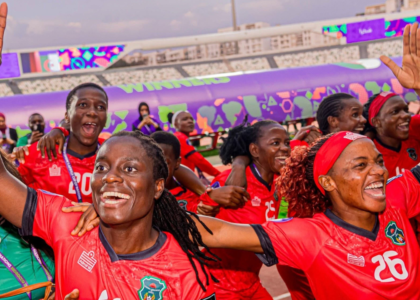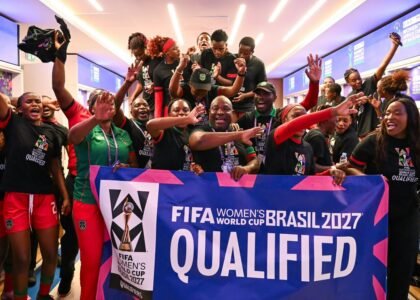

Six years ago, Tabitha Chaŵinga said Malawi dreamed of reaching the Women’s World Cup. Now she and Temwa have helped make it real.
In October 2020, Tabitha Chaŵinga spoke to FIFA about Malawi.
At the time, she and her younger sister Temwa were already building extraordinary careers abroad.
They had played in Sweden.
They were thriving in China.
They had already demonstrated what the Chaŵinga name could mean in international club football.
But there was still something they had never experienced with Malawi.
A major global tournament.
Tabitha said it plainly:
Malawi had never qualified for the Women’s World Cup.
The competition represented their hopes.
And if the team kept working, perhaps one day they could reach that level and realise the dream.
Six years later:
Malawi are going to the FIFA Women’s World Cup.
Brazil 2027.
The dream is now a fixture on the calendar.
Before the World Cup dream came the WAFCON dream
There was another barrier first.
Malawi had never even qualified for the Women’s Africa Cup of Nations.
For years, that continental tournament remained the gate Malawi could not pass through.
That fact made Tabitha’s words before Malawi’s opening match against Nigeria in July 2026 particularly significant.
She told CAF that playing at WAFCON had itself been a dream.
Now the time had come.
The challenge awaiting Malawi was enormous.
Their first WAFCON opponent was not another debutant.
It was Nigeria.
Ten-time African champions.
Defending champions.
A country that had never lost to a tournament debutant in WAFCON history.
Malawi were ranked 153rd in the world.
Nigeria had decades of continental pedigree.
But Tabitha’s message before kick-off was not about survival.
It was about competing without inferiority.
Then the sisters walked onto the pitch.
The first WAFCON goal belongs to Temwa
For 72 minutes, Malawi stayed with Nigeria.
Then, in the 73rd minute:
Temwa Chaŵinga.
Malawi’s first-ever goal at a Women’s Africa Cup of Nations.
Six minutes later:
Tabitha Chaŵinga.
2–0.
Then Nigeria pulled one back.
And deep into stoppage time:
Temwa again.
Malawi won 3–2.
The sisters had scored all three goals in the country’s first-ever match at the continental championship. CAF later confirmed another extraordinary first: Temwa and Tabitha became the first siblings to score in the same WAFCON match.
For Temwa, the brace also earned the first of what would become multiple Woman of the Match awards in this tournament.
The World Cup dream was still distant.
But suddenly, Malawi had proof that it belonged.
Egypt: Temwa creates and scores
The next game showed that the Nigeria result was not simply one extraordinary night.
Against Egypt, Temwa became central to the game in a different way.
She helped create Rose Kadzere’s opening goal with a perfectly weighted pass.
Faith Chinzimu scored the second.
Then Malawi went down to ten players after Rose Alufandika was sent off.
A less confident team might have retreated completely.
Instead, Malawi attacked again.
Rose Kadzere turned provider.
Temwa headed home Malawi’s third.
Malawi 3–1 Egypt.
By then, Temwa had already produced three goals and an assist across Malawi’s first two WAFCON matches.
The tournament had begun to acquire a pattern.
When Malawi needed to change the emotional direction of a match, Temwa kept appearing.
Zambia: Tabitha understands what Malawi needs
The final group match against Zambia asked for something different.
Malawi went 2–0 down.
Nigeria were simultaneously beating Egypt.
That created a three-way tie between Malawi, Nigeria and Zambia.
All three teams were heading toward six points.
The arithmetic became complicated.
Malawi did not necessarily need to win.
They did not necessarily need to draw.
They needed a goal.
One.
In the 72nd minute, Tabitha delivered it.
She beat two defenders and drove a low finish past the goalkeeper.
Zambia 2–1 Malawi.
The Scorchers still lost the match.
But that single goal changed the head-to-head calculations.
Malawi finished top of Group C.
Zambia, despite winning the match, went home.
It was one of the most unusual important goals of Tabitha’s international career.
Not a winner.
Not an equaliser.
A goal that understood the tournament.
Ghana: ninety minutes from the World Cup
Then came the match that had lived in the sisters’ imagination for years.
Malawi versus Ghana.
Quarter-final.
Win, and the Scorchers would qualify for the FIFA Women’s World Cup.
There was no longer any complicated mathematics.
The equation was brutally simple.
Ghana scored first.
Seventh minute.
Five minutes later:
Temwa Chaŵinga.
1–1.
Again, the response was immediate.
Again, Temwa altered the emotional state of the match before Malawi could begin to panic.
Then, in the 79th minute:
Rose Kadzere.
2–1.
And Temwa was involved again, supplying the assist for the goal that sent Malawi to Brazil.
At full time, a dream Tabitha had spoken about publicly six years earlier had become reality.
Malawi had qualified for its first FIFA Women’s World Cup.
Not just the sisters anymore
There is something important about who scored the winning goal.
For much of the outside world, Malawian women’s football is synonymous with the Chaŵinga sisters.
That is understandable.
But the World Cup-clinching winner belonged to Rose Kadzere.
Faith Chinzimu had already scored the two goals against Angola that qualified Malawi for WAFCON in the first place.
Mercy Sikelo had repeatedly made the saves that kept Malawi alive.
The sisters had raised the ceiling.
Now the team around them was reaching for it.
That may be the most powerful part of the World Cup qualification.
Tabitha and Temwa did not drag Malawi to Brazil alone.
They helped create a team capable of getting there with them.
Temwa’s WAFCON
By the end of the Ghana quarter-final, Temwa had:
4 goals
2 assists
6 goal involvements
and had been named Woman of the Match twice during Malawi’s historic run.
She had scored against:
Nigeria twice.
Egypt.
Ghana.
Only Zambia had prevented her from finding the net.
CAF had her one goal behind Barbra Banda in the Golden Boot race going into the semi-final.
Then came Algeria.
Algeria: the sisters take over again
The semi-final was another reminder of just how extraordinary the relationship between these two players has become.
Tabitha scored first.
An athletic finish after the ball came back off the bar.
Then Temwa scored before half-time.
Then Algeria pulled one back.
And in the 76th minute:
Tabitha again.
Malawi 3–1 Algeria.
All three goals.
Two sisters.
One national team.
One place in the WAFCON final.
Tabitha’s brace earned her Woman of the Match.
And Temwa’s goal moved her to five for the tournament.
Nine of twelve
Through five matches, Malawi have scored:
12 goals.
The Chaŵinga sisters have scored:
9 of them.
Temwa:
5.
Tabitha:
4.
That means the sisters have produced 75% of Malawi’s goals at their first-ever WAFCON.
And the five matches tell the story clearly.
Nigeria
Temwa
Tabitha
Temwa
Egypt
Kadzere
Chinzimu
Temwa
Zambia
Tabitha
Ghana
Temwa
Kadzere
Algeria
Tabitha
Temwa
Tabitha
Different game states.
Different pressures.
Same two names appearing again and again.
Malawi are the tournament’s highest-scoring team
The Scorchers have not simply survived their first WAFCON.
They have attacked it.
Malawi entered the semi-finals as the highest-scoring team among the final four, with nine goals.
Then they put three past Algeria.
That takes them to 12 goals in five matches going into the final.
No team remaining in the tournament has matched that output.
Malawi have scored against every opponent they have faced.
They have scored with eleven players.
They have scored with ten.
They have scored first.
They have scored after falling behind.
They have scored against the defending champions.
They have scored in a quarter-final with a World Cup place on the line.
They have scored three times in a continental semi-final.
This team’s identity has not been built around controlling possession.
It has been built around turning possession into danger.
And nobody has embodied that danger more consistently than Temwa and Tabitha.
The Golden Boot is within reach
There is one more individual storyline entering the final.
Temwa now has five WAFCON goals.
That places her level with Zambia’s Barbra Banda, whose tournament is already over.
Before the semi-final, Banda led with five and Temwa had four.
Temwa’s goal against Algeria pulled her level.
That means Temwa goes into the final against Cameroon with an opportunity to finish the tournament as its leading scorer.
Another goal could put the Golden Boot beyond doubt.
It would not be unfamiliar territory.
Temwa has already won:
the 2023 COSAFA Golden Boot;
the 2024 NWSL Golden Boot;
and the 2025 NWSL Golden Boot.
She has built a career around scoring titles.
But the distinction matters:
the evidence we have from her public comments suggests that the individual award is not the priority.
The title is.
The Golden Boot can come with it.
Three Woman of the Match awards between the sisters
There is another measure of their influence.
Through the semi-final, the sisters have collected at least three confirmed WAFCON Woman of the Match awards between them.
Temwa — 2
Tabitha — 1
Temwa’s two came during Malawi’s historic run through the group and knockout stages.
Tabitha’s came in the semi-final after her two goals against Algeria.
For two players entering their first WAFCON, that is an extraordinary concentration of individual recognition.
But it also mirrors what has happened on the field.
Malawi’s campaign has repeatedly turned around moments produced by one sister or the other.
Six years between the sentence and the reality
That is what makes the old FIFA interview so powerful now.
In 2020, Tabitha spoke of the Women’s World Cup as something Malawi had never reached.
A hope.
A dream.
Something that might become possible if the team kept working.
At the time, the sisters themselves were already succeeding internationally.
They had played in Sweden.
They were playing in China.
They were proving that Malawian women could succeed abroad.
But the national team had not caught up with them yet.
Six years later, everything has changed.
Tabitha has become one of Europe’s established elite players.
Temwa has become one of the dominant forwards in world football.
And Malawi has become a World Cup nation.
The dream now belongs to more than two people
Perhaps this is where the story has moved furthest.
In 2020, the World Cup dream could easily have sounded like the ambition of two extraordinary sisters trying to pull a small football programme toward something much larger.
In 2026, it belongs to an entire dressing room.
Faith Chinzimu has spoken about what World Cup qualification would mean for young girls in Malawi and about how the Chaŵinga sisters show younger players that someone from Malawi can reach the top.
Rose Kadzere scored the goal that actually secured qualification.
Mercy Sikelo has protected Malawi through some of the tournament’s most difficult moments.
Lovemore Fazili has taken the programme from COSAFA champions to WAFCON finalists and World Cup qualifiers.
The dream has expanded.
And now there is one more dream
The World Cup place is secured.
Brazil is waiting.
There is nothing Cameroon can do on Sunday to take that away from Malawi.
But there is one unfinished piece of business in Morocco.
The WAFCON trophy.
Malawi entered this competition as debutants.
Ranked 153rd in the world.
They have beaten Nigeria.
They have beaten Egypt.
They have survived Zambia and still won the group.
They have beaten Ghana to qualify for the World Cup.
They have beaten Algeria to reach the final.
They are the tournament’s highest-scoring team.
Temwa is tied at the top of the Golden Boot race.
Tabitha has just produced a two-goal Woman of the Match performance in the semi-final.
And the sisters who once talked about reaching a World Cup are now one match away from becoming champions of Africa.
That is the strange thing about dreams.
You spend years imagining one destination.
Then you finally arrive.
And discover another one waiting beyond it.
Brazil 2027 is real.
Now:
why not the cup?