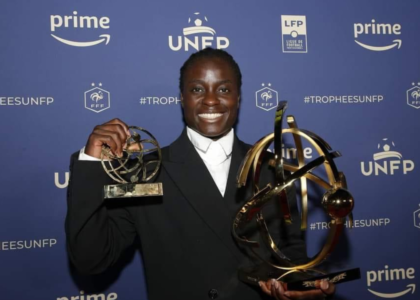

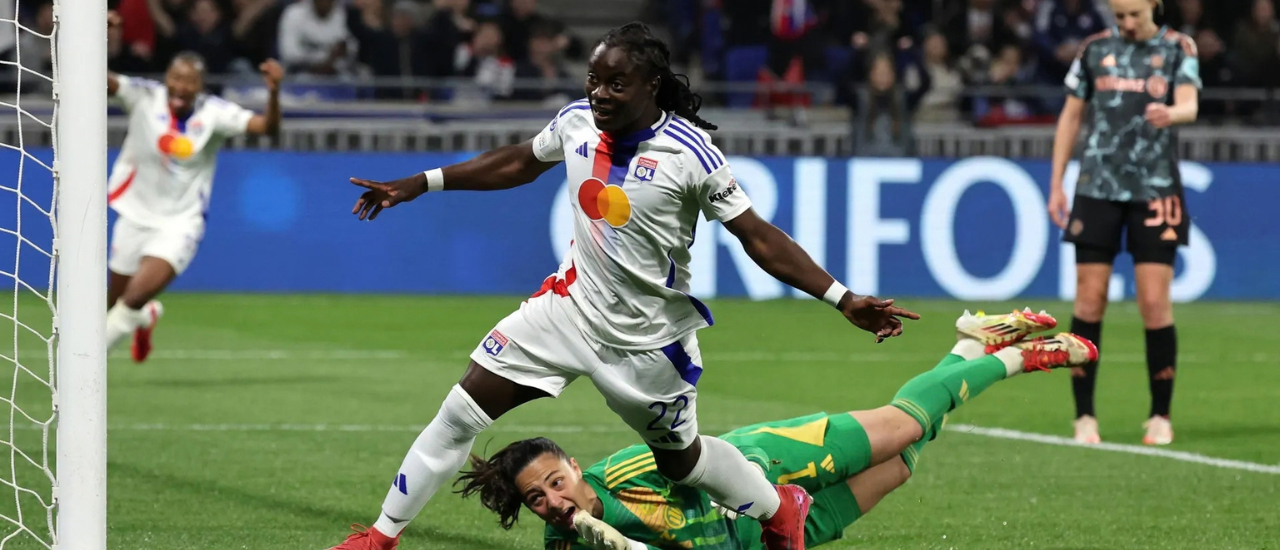
Before Tabitha Chaŵinga could become one of the most dangerous forwards in European football, Malawi first had to enter a competition it had never touched. Three seasons later, she has been a semi-finalist, a finalist, one of UEFA’s best forwards and repeatedly one of the fastest players on the pitch. The trophy is the one thing still missing.
To understand what Tabitha Chaŵinga is doing in European football, it helps to begin somewhere that football coverage often does not: with the architecture.
There are effectively two parallel worlds in elite football. One is international football, where players represent countries. Malawi’s Scorchers compete in tournaments such as the Women’s Africa Cup of Nations under the Confederation of African Football, and ultimately the FIFA Women’s World Cup. The other is club football, where those same players spend most of the year employed by professional teams in domestic leagues around the world.
Tabitha is captain of Malawi when she plays international football. In club football, however, she plays in France for OL Lyonnes.
The UEFA Women’s Champions League sits above Europe’s domestic leagues as their premier continental competition. It does not replace those leagues. It takes the strongest clubs produced by them and places them into a second, cross-border layer of competition.
For someone approaching football from outside the sport, a useful way of thinking about it is this: winning your domestic league establishes that you are among the strongest businesses in your national market. The Champions League asks whether that strength survives when the market becomes continental.
That is why the competition matters.
And that is the level at which Tabitha Chaŵinga is now operating.
First, what is the UEFA Women’s Champions League?
Europe does not have one women’s football league. England has its Women’s Super League. France has the Première Ligue. Spain has Liga F. Germany has the Frauen-Bundesliga. Italy has Serie A Women, and so on.
Each is a separate domestic ecosystem, with its own clubs, supporters, commercial structures and championship.
UEFA — the Union of European Football Associations — provides the layer above them.
In 2000, UEFA approved the creation of a continental women’s club competition. The inaugural UEFA Women’s Cup was played in 2001/02, with 33 clubs entering and Frankfurt becoming its first champion. Beginning with the 2009/10 season, the competition was relaunched under the name it carries today: the UEFA Women’s Champions League. UEFA.com
The simplest description is also the most useful: it is the highest level of European women’s club football.
Qualification is earned primarily through performance in national leagues. There is no permanent membership simply because a club is famous or commercially valuable. Domestic results determine which clubs qualify directly and which must survive qualifying rounds. From 2025/26, UEFA expanded the main competition into an 18-team league phase. Each club now faces six different opponents — three at home and three away — rather than repeatedly playing three teams in a traditional four-team group. The top four go directly to the quarter-finals; clubs ranked fifth through twelfth enter knockout play-offs; the remaining six are eliminated. UEFA.com
That format matters because it deliberately creates more encounters between elite teams earlier in the tournament. A club can face Chelsea, Barcelona, Arsenal, Bayern Munich or Lyon before the traditional knockout rounds even begin.
The competition is also increasingly important as a commercial product. Beginning with the 2025/26 cycle, UEFA fully centralised media and sponsorship rights from the league phase onward and introduced a larger financial-distribution model across its women’s club competitions. UEFA projected €37.7 million per season for distribution during both 2025/26 and 2026/27 across the Women’s Champions League, Women’s Europa Cup, qualifying participants and solidarity payments to non-participating clubs.
That figure remains modest relative to the enormous economics of men’s European football. But the strategic direction is significant. UEFA is no longer treating elite women’s club football merely as a tournament calendar. It is building a consolidated media property: centralised rights, more marquee fixtures, a second-tier continental competition, wider club participation and a clearer pathway for commercial growth.
In other words, the Champions League is both a sporting championship and an increasingly valuable distribution platform for women’s football.
For players, it is also a market signal.
A forward can dominate one domestic league. A Champions League campaign asks whether the same player can produce against champions, international defenders and technically sophisticated teams drawn from across Europe.
That distinction is important to Tabitha’s story.
Because when she finally entered this competition, she did not spend much time introducing herself.
Before Europe’s biggest stage, a decade of building
By the time most European audiences encountered Tabitha Chaŵinga, she was already an established professional footballer.
Her European story had actually begun almost a decade earlier.
In 2014, at 18, she moved to Sweden and became the first Malawian woman to play professional club football in Europe. She scored 39 goals in 18 matches for Krokom/Dvärsätts IF before moving to Kvarnsvedens, where her goals helped take the club into Sweden’s top division. FIFA has documented that early Swedish chapter as the point at which Chaŵinga began opening a route that her younger sister Temwa would later follow.
China followed. Then Italy.
At Inter Milan during the 2022/23 season, Tabitha became the first African woman to finish as Serie A’s leading scorer. By the time she moved on loan to Paris Saint-Germain in 2023, she was not an obscure prospect waiting to be discovered. She had already demonstrated that her production could travel across football systems.
What she had not yet done was play in the Champions League.
That changed on 10 October 2023, in Manchester.
Paris Saint-Germain were attempting to qualify for the group stage and faced Manchester United away in the first leg of their second qualifying-round tie. Early in the second half, Sandy Baltimore released Chaŵinga behind the defence.
She finished.
PSG eventually drew the match 1–1, but the goal belonged to a much larger history.
UEFA recorded Tabitha Chaŵinga as both the first Malawian to appear in the UEFA Women’s Champions League and the first Malawian to score in UEFA competition. UEFA.com
That sentence warrants some attention.
Not the first Malawian woman to score in the Women’s Champions League.
The first Malawian to score in UEFA competition.
A country entered a European scoring record through her.
PSG won the second leg 3–1 in Paris, advanced 4–2 on aggregate and entered the group stage. Tabitha’s first Champions League campaign was underway.
It would become considerably more than symbolic.
2023/24: from first Malawian to one of Europe’s best
There is a tendency in sports storytelling to treat historical firsts as if the achievement ends with arrival.
It would have been significant if Tabitha Chaŵinga had simply become Malawi’s first Women’s Champions League player. That is not what happened.
She became one of the best forwards in the tournament.
Across PSG’s run, she scored six goals in the European campaign when qualifying is included. Five of those came from the group stage onward, which is why different statistical databases can appear to give different totals. PSG’s own season summary records five goals and two assists across ten matches in the competition proper, while UEFA later described her goal against Lyon in the semi-final as her sixth of the full European campaign. Paris Saint-Germain
That distinction is worth preserving because football statistics are often reported under different conventions. Some competition tables exclude qualifying rounds. Career narratives often include them. Both can be correct if the denominator is clear.
More important than the accounting method was what UEFA’s technical observers concluded after watching the tournament.
At the end of the 2023/24 season, UEFA selected Chaŵinga in its Women’s Champions League Team of the Season.
The forward line consisted of Barcelona’s Caroline Graham Hansen, Lyon’s Kadidiatou Diani and Paris Saint-Germain’s Tabitha Chaŵinga. The wider XI included players such as Aitana Bonmatí, Lindsey Horan, Lucy Bronze, Irene Paredes and Christiane Endler. UEFA.com
For a reader unfamiliar with football awards, this is more significant than merely being selected for an all-star graphic.
UEFA’s Technical Observer panel evaluates the competition itself. The selection therefore amounted to a judgement that, over her first campaign at this level, Chaŵinga had performed as one of the tournament’s elite forwards.
She did that during the same season in which she was also named the best player in France’s domestic league.
The Champions League provided external validation that her dominance was not simply a function of domestic opposition.
She travelled.
Her game scaled.
And as PSG moved deeper into the tournament, the story acquired an almost too-perfect narrative turn.
Their semi-final opponent was Lyon.
The club that eliminated her became the club that signed her
To understand Lyon’s significance, it helps again to zoom out.
If the Women’s Champions League is the summit of European club football, Lyon are its most accomplished institution.
They have won the European title eight times, more than any other women’s club. Their run included five consecutive championships between 2016 and 2020. As of the start of the 2026/27 season, no other club has matched their total. Barcelona, the current European champions, have four. UEFA.com
Lyon are therefore not simply another strong French side.
They are one of the institutions that built the modern competitive standard of European women’s football.
In April 2024, Tabitha’s PSG faced them for a place in the Champions League final.
Lyon won the first leg 3–2. In the return match in Paris, PSG needed to overturn the deficit.
Chaŵinga scored.
Marie-Antoinette Katoto recovered possession and released her into space; Chaŵinga carried the ball into the penalty area and drove a low finish across goal. It briefly brought PSG level on the night and gave them hope of recovering the tie.
Lyon eventually won 2–1 and advanced 5–3 on aggregate. UEFA.com
For Tabitha, the first Champions League campaign was over one stage short of the final.
A few months later, the institution that had ended that run signed her.
In July 2024, Chaŵinga joined Olympique Lyonnais permanently after her PSG loan. UEFA’s preview of her first Champions League campaign with Lyon explicitly identified the attributes she was adding to an already elite attack: power, pace and finishing. UEFA.com
There is something important in that transaction beyond the romance of “if you can’t beat them, join them.”
Elite clubs do not recruit sentiment.
They allocate capital to performance.
Lyon had watched Chaŵinga compete against them domestically and in Europe. The player they chose to acquire was a forward who had just been recognised as France’s best player and one of the Champions League’s three best attackers.
For a Malawian footballer, that represented another shift in scale.
She was no longer trying to break into the European elite.
One of Europe’s most successful institutions had decided she belonged inside it.
2024/25: the second semi-final, now wearing Lyon colours
Her second Champions League season therefore began under completely different expectations.
At PSG, Chaŵinga had arrived as a newcomer to European competition.
At Lyon, she had joined an organisation for which reaching the final was not a fantasy. It was an operating expectation.
This is one of the peculiarities of playing for a historically dominant club: success is measured against its own history.
For many teams, reaching a Champions League quarter-final is evidence of progress. For Lyon, a quarter-final is closer to a minimum standard. By March 2025, the club had reached that stage in 15 of the previous 16 campaigns. UEFA.com
Their quarter-final opponent was Bayern Munich.
And this is where Chaŵinga’s directness became useful.
In the first leg in Munich, a ball was played into space down Lyon’s left. Tabitha accelerated onto it, carried possession inside and finished past goalkeeper Maria-Luisa Grohs.
It was her first Champions League goal for Lyon.
Lyon won 2–0.
Eight days later, Bayern scored first in the return leg and threatened, briefly, to make the tie uncomfortable.
Then Lyon accelerated.
Melchie Dumornay scored. Kadidiatou Diani scored. And on the hour, Diani found Chaŵinga at the far post.
Tabitha scored again.
Lyon won the match 4–1 and the quarter-final 6–1 on aggregate. Chaŵinga had scored in both legs. UEFA.com
The semi-final brought Arsenal.
Lyon won the first leg 2–1 in London and returned home with control of the tie. Arsenal then produced one of the performances of the tournament, winning 4–1 in France and advancing 5–3 on aggregate. UEFA.com
For the second consecutive season, Chaŵinga’s Champions League ended in the semi-finals.
Different club.
Same stage.
Still no final.
But another dataset was beginning to reveal something distinctive about the way she was influencing these matches.
She was extraordinarily fast.
33.1 km/h: what speed actually means in football
Speed statistics are seductive because they look self-explanatory.
A player runs 33.1 kilometres per hour. Another runs 31.7. Therefore, the first player is faster.
But football is not a 100-metre race.
Raw sprint velocity matters because of what it changes around the player.
During Chaŵinga’s first Champions League season, reporting based on competition tracking data placed her at a top speed of 33.1 km/h, ahead of Lyon’s Melchie Dumornay at 31.7 km/h.
| UWCL season | Club | European finish | Tabitha speed marker |
|---|---|---|---|
| 2023/24 | PSG | Semi-final | 33.1 km/h |
| 2024/25 | Lyon | Semi-final | 31.3 km/h |
| 2025/26 | OL Lyonnes | Final | 31.5 km/h |
| 2026/27 | OL Lyonnes | In progress | TBD |
What the evidence does support is already remarkable: 33.1 km/h was reported as the highest speed in the 2023/24 competition.
In 2024/25, reporting around the quarter-finals again placed Chaŵinga at the top of the tournament’s speed rankings, this time at 31.3 km/h, just ahead of Lyon teammate Ellie Carpenter at 31.2. Goal
Then came 2025/26.
UEFA’s own end-of-season analysis recorded Chaŵinga at 31.5 km/h, the fastest speed registered by any player from the quarter-finals onward. Dumornay followed at 31.4 and Ashley Lawrence at 31.2.
Three seasons.
Two clubs.
Different coaches, teammates and tactical contexts.
And the same competitive advantage keeps reappearing.
That is the more interesting insight.
Speed is not a novelty attached to Tabitha Chaŵinga’s profile. It is a repeatable part of her production.
For a defender, an attacker with that pace changes the calculation before the attacker even receives the ball. Play too high up the pitch and a pass behind you can become a one-on-one. Drop deeper to protect against the run and you concede space in front of the defensive line. Send a second defender toward her and another attacker may become free.
The effect is therefore partly visible and partly structural.
Sometimes the value of Chaŵinga’s pace is the sprint everyone sees.
Sometimes it is the five metres a defender retreats because she knows the sprint is possible.
This is also why reducing her game to “she is fast” misses the point.
Speed without timing frequently produces nothing. Elite defenders are fast too. At Champions League level, runs need to be made into the correct spaces, at the correct moment, relative to the position of the ball and the defensive line.
The Bayern goal in 2025 is instructive. The value was not simply the maximum velocity. It was the recognition of space, the movement into it, the ability to carry the ball while the defence retreated, and the finish after the sprint.
Acceleration creates the opportunity.
Football intelligence determines whether it becomes a goal.
2025/26: the final finally arrives
By Chaŵinga’s third Champions League campaign, the competition itself had changed.
UEFA abolished the old four-team group system and introduced the 18-club league phase. Instead of playing three opponents twice, each club faced six different teams. The redesign was intended to create more varied opposition and more high-level fixtures without increasing the six-match burden of the opening phase. UEFA.com
Lyon — by then competing under the OL Lyonnes identity — went through the new system and returned to familiar territory in the knockout rounds.
There were difficult moments.
Away to Juventus in the league phase, Lyon were 3–0 down at half-time. Chaŵinga began the recovery by scoring on the hour. Marie-Antoinette Katoto pulled another back before Wendie Renard converted a late penalty to rescue a 3–3 draw. UEFA.com
By the semi-finals, there was a familiar opponent waiting.
Arsenal.
Twelve months earlier, Arsenal had eliminated Lyon in France.
This time Arsenal again won the first leg, 2–1 in London. Lyon returned home needing to reverse the tie.
They did.
A Wendie Renard penalty and Kadidiatou Diani goal overturned the aggregate deficit. Alessia Russo pulled Arsenal level. Then, with four minutes remaining, Jule Brand scored the goal that sent Lyon through 4–3 on aggregate.
For the first time in Tabitha Chaŵinga’s career, she was going to the UEFA Women’s Champions League final. UEFA.com
There is an important distinction here because her progression can otherwise be misreported.
Her first PSG campaign in 2023/24 ended in the semi-final.
Her first Lyon campaign in 2024/25 ended in the semi-final.
Her second Lyon campaign, 2025/26, reached the final.
Three seasons produced a clear progression:
semi-final, semi-final, final.
The final was held in Oslo on 23 May 2026.
The opponent was Barcelona.
Chaŵinga did not start because she had just come off an injury. OL Lyonnes began with Vicki Becho, Ada Hegerberg and Jule Brand across the forward line. With Lyon trailing in the second half, Chaŵinga and Katoto entered in the 66th minute.
Almost immediately, Tabitha was released behind Barcelona’s defence and found herself through on goal.
Cata Coll saved.
It was the type of situation Chaŵinga’s game is built to create: space, transition, acceleration, separation.
This time it did not become the goal Lyon needed.
Barcelona won 4–0, with Ewa Pajor and Salma Paralluelo each scoring twice, and claimed their fourth European title.
Lyon had reached a record twelfth final.
Tabitha had reached her first.
The medal was silver.
Why the Champions League matters differently for Malawi
This is the point at which a purely European telling of the story becomes insufficient.
For players from football’s most commercially developed countries, the Champions League is the highest step in an already visible system. A young French player can grow up watching French internationals at Lyon or Paris Saint-Germain. An English player can see Champions League football staged in major domestic stadiums. A Spanish player can watch Barcelona win European titles and plausibly trace a pathway through professional academies toward that environment.
Malawi’s pathway has historically looked very different.
Tabitha did not emerge from a domestic women’s football economy with the same professional infrastructure, commercial investment or international visibility.
Her route ran from Malawi to Sweden, from Sweden to China, from China back into Europe through Italy, then Paris, then Lyon.
That matters because careers like hers carry information back down the system.
They demonstrate that the distance between a Malawian player and a Champions League final is not theoretical.
It has been travelled.
And increasingly, performance at this level creates a second effect: it changes how scouts, clubs, agents, sponsors and audiences evaluate the market that produced the player.
Football talent has always been globally distributed more widely than football capital.
The challenge is discovery, development and access.
A player succeeding repeatedly at the top of the value chain makes it harder to dismiss the bottom of that chain as irrelevant.
That may ultimately be one of the more important consequences of the Chaŵinga era.
Tabitha’s achievements are individual.
Their informational value is systemic.
And now, the fourth campaign
The story is not retrospective because the fourth chapter has already begun.
The 2026/27 UEFA Women’s Champions League league phase started on 22 September. It is only the second season under the new 18-team format. OL Lyonnes opened their campaign away to Servette and won 8–0, with Marie-Antoinette Katoto scoring a hat-trick and Melchie Dumornay scoring twice. Chaŵinga featured for 25 minutes.
Next comes considerably stronger opposition.
On 30 September 2026, Lyon host Chelsea.
Then Inter.
Then Juventus.
Then Arsenal — the club that eliminated Lyon in 2025 and nearly eliminated them again in 2026.
The league phase concludes against Häcken in December.
The destination, for everybody, is Warsaw. The 2027 final will be staged at Poland’s National Stadium in May.
For Tabitha Chaŵinga, the assignment is increasingly specific.
She no longer needs to demonstrate that a Malawian can play in the Women’s Champions League.
She did that on her first night.
She no longer needs to demonstrate that she can score at this level.
She scored in her first appearance.
She no longer needs to demonstrate that she belongs among Europe’s leading forwards.
UEFA put her in its Team of the Season.
She no longer needs to demonstrate that her physical profile translates against elite European competition.
Three consecutive Champions League campaigns have produced elite speed data, including 33.1 km/h in her first season and a UEFA-confirmed competition-leading 31.5 km/h from the quarter-finals onward in her third.
She has played for two of France’s largest clubs.
She has scored in quarter-finals.
She has scored in a semi-final.
She has now played in a final.
At 30, entering her fourth European campaign, the distance between Tabitha Chaŵinga and the summit of European club football has become very small.
One match, in fact.
One result.
One trophy.
And for someone who began this journey by becoming the first Malawian woman to play professional football in Europe, perhaps that is the most useful way to understand where the story now stands.
Tabitha Chaŵinga is no longer trying to reach European football.
European football is now the arena in which her legacy is being decided.