

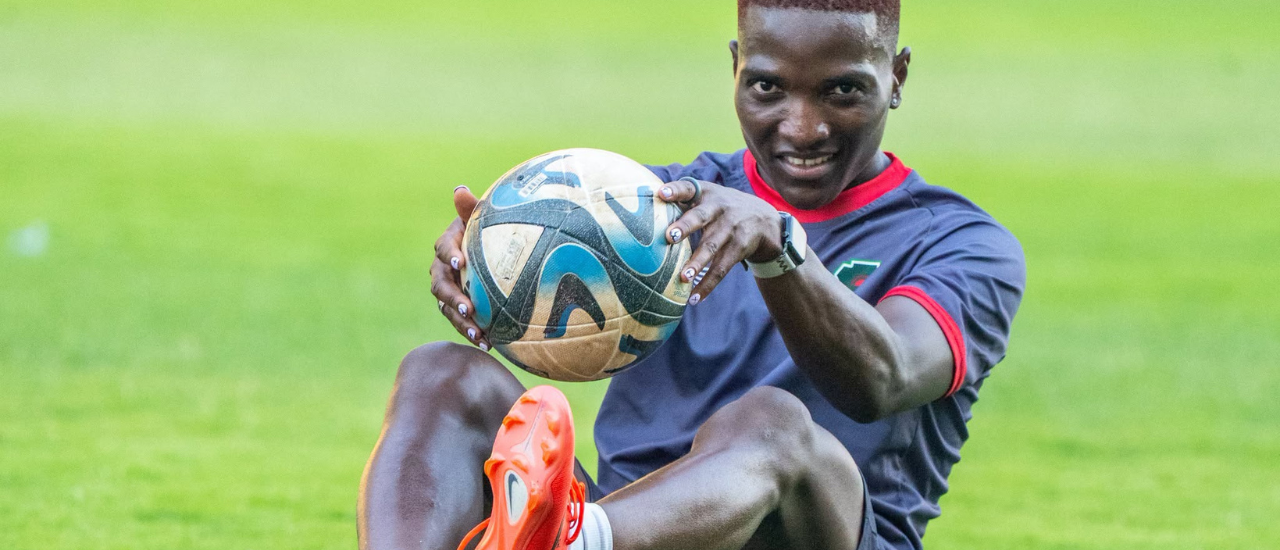
The Malawi Women’s National Football Team, the Scorchers, begin another major international campaign on Friday, 9 October 2026, when they host Zimbabwe’s Mighty Warriors at Bingu National Stadium in Lilongwe in the first leg of their African qualifiers for the Los Angeles 2028 Olympic Games.
The match arrives at an unusual moment in the trajectory of Malawian women’s football.
Malawi is no longer entering continental competition as an unknown quantity. The Scorchers are now WAFCON silver medallists, FIFA Women’s World Cup qualifiers and one of the most closely watched emerging teams in African women’s football. Their task now is to determine whether that breakthrough becomes a singular sporting moment or the foundation of sustained international relevance.
Olympic qualification will test that proposition immediately.
Thirty-five African nations entered the qualification pathway.
Only two will represent Africa at LA28.
That is the competitive context in which Malawi and Zimbabwe meet.
What are the Los Angeles 2028 Olympic Games?
The Los Angeles 2028 Olympic Games, commonly known as LA28, will be staged in the United States from 14–30 July 2028. Los Angeles will become an Olympic host city for the third time, following the 1932 and 1984 Games.
Football begins before the Opening Ceremony, with the tournament scheduled to start on 10 July. The women’s competition will feature 16 national teams, with matches played across seven U.S. cities before the medal stages culminate at the Rose Bowl in Pasadena. The women’s gold-medal match is scheduled for 29 July 2028.
For Malawi, simply reaching that tournament would represent another historic first.
But getting there is exceptionally difficult.
Africa has only two places
CAF’s women’s Olympic qualification process began with 35 participating nations and runs across five rounds of home-and-away knockout football.
The six lowest-ranked teams began in Round 1. Malawi received a bye into Round 2.
From there, the field contracts quickly:
16 teams → 8 teams → 4 teams → 2 Olympic qualifiers.
The two winners of the final round will take Africa’s places at LA28.
That makes Olympic qualification structurally different from WAFCON.
At WAFCON, Malawi qualified for a final tournament, entered a group stage and could build a campaign over several matches. Olympic qualification offers no such cushion.
Every round is elimination football.
Two matches. One aggregate result. One team continues.
Why Zimbabwe matters
Malawi’s first obstacle is not theoretical.
It is Zimbabwe.
The first leg takes place at Bingu National Stadium on Friday, 9 October, at 15:00, with the return leg scheduled for Harare on 13 October. The winner will advance to face either Kenya or Seychelles in the next round in February 2027.
Zimbabwe has already made clear that it is treating the fixture as a serious competitive assignment.
The Mighty Warriors travelled to Malawi by chartered flight, specifically to minimise travel fatigue and maximise recovery time ahead of the first leg. Their first training session in Malawi is scheduled for Thursday, giving head coach Stella Gotal one final opportunity to work through tactical combinations before the match.
That operational detail matters.
At this level, preparation is part of performance. Travel, recovery, training time and player availability all shape the quality of what eventually appears on the pitch.
Zimbabwe is arriving prepared.
The Mighty Warriors come with history
Zimbabwe is not new to the Olympic stage.
The Mighty Warriors qualified for the Rio 2016 Olympic Games, making them one of the relatively small number of African women’s teams to have experienced Olympic football.
They also arrive in Lilongwe with a recent memory that should command Malawi’s attention.
On 28 November 2025, Zimbabwe beat Malawi 2–1 at Bingu National Stadium during the Three Nations Women’s Tournament. Ethel Chinyerere scored twice in the first half, while Faith Chimzimu pulled one back for Malawi.
That result gives this fixture a useful layer of history.
The Scorchers may now be continental silver medallists, but Zimbabwe has already shown that it can come to Lilongwe and win.
Who should Malawi be wary of?
Zimbabwe’s current squad combines domestic experience with players based abroad.
Captain Emmaculate Msipa provides midfield leadership and Olympic experience from the Rio 2016 generation.
Ethel Chinyerere is perhaps the most immediate reminder of the threat Zimbabwe carries: she scored both goals in that 2–1 victory over Malawi at Bingu National Stadium last year.
Rutendo Makore remains one of Zimbabwe’s more experienced attacking players, while Ruvimbo Mucherera, currently listed with Maccabi Tel Aviv, gives the Mighty Warriors another established attacking option.
There is also a newer generation emerging. Samiah Phiri, who previously spent time in France with FC Nantes and has also been associated with the United States player pathway, is part of a broader attempt to widen Zimbabwe’s recruitment pool.
Gotal’s stated focus has been on improving combinations, possession structure, defensive organisation and transition play. Zimbabwe does not appear intent on turning the fixture into an uncontrolled end-to-end contest. The preparation has instead emphasised understanding roles both in and out of possession.
That makes the tactical contest interesting.
Malawi’s greatest attacking strength is speed, directness and the ability to punish space.
Zimbabwe appears to be preparing specifically to deny it.
And then there is Bingu National Stadium
The venue itself carries its own recent lore.
Bingu National Stadium has already been the setting for several important chapters in the rise of the Scorchers.
On 28 October 2025, Malawi beat Angola 2–0 at BNS to qualify for its first-ever WAFCON.
Thousands of supporters filled the stadium after FAM opened the gates for free. The match remained goalless deep into the second half before Tabitha Chawinga broke down the left and supplied Faith Chimzimu for the opening goal in the 82nd minute. Chimzimu scored again barely a minute later.
The stadium erupted.
Malawi was going to WAFCON.
One month later, BNS also provided a reminder that home advantage does not guarantee results.
Zimbabwe came to the same stadium and won 2–1. Malawi then drew 1–1 with Zambia two days later.
So Bingu already contains both sides of the Scorchers’ recent history: qualification and celebration, but also warning.
Friday adds another chapter.
Malawi is bringing much more than the Chawinga sisters
The global profile of Tabitha and Temwa Chawinga understandably attracts attention, but this Scorchers team is not simply a two-player proposition.
Coach Lovemore Fazili has retained much of the group that carried Malawi through WAFCON while also introducing new players into the national-team system.
The current squad reflects an increasingly international player base.
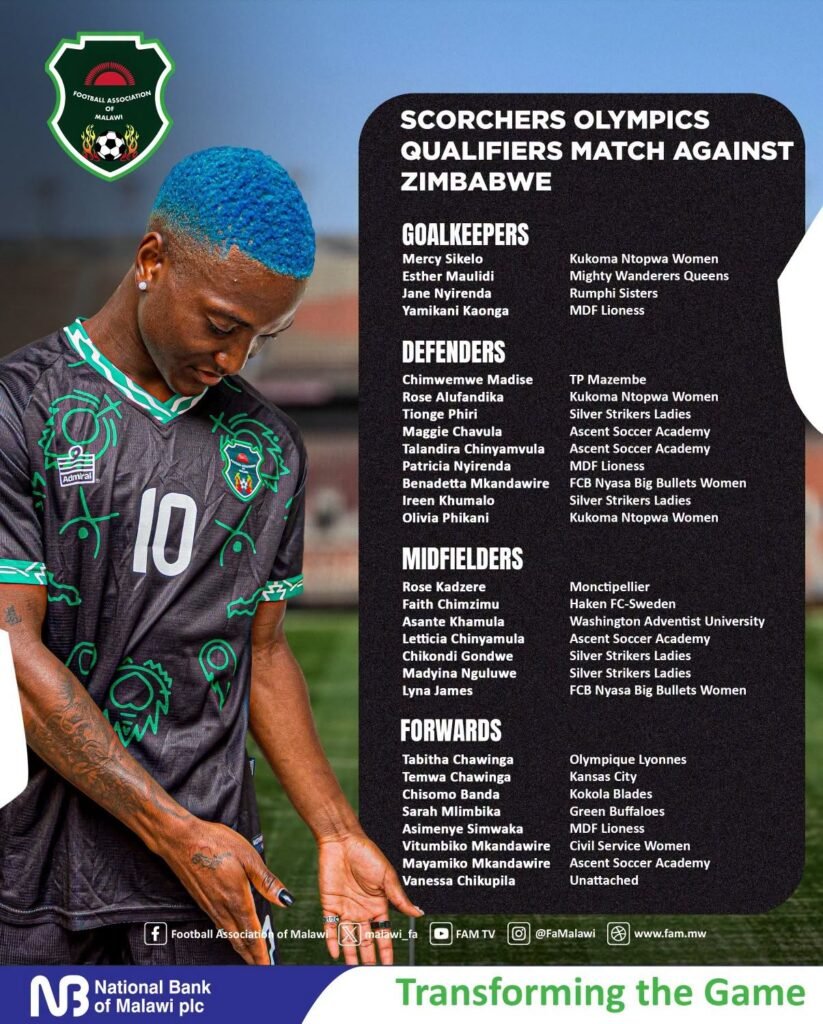
Tabitha Chawinga arrives from Olympique Lyonnais.
Temwa Chawinga arrives from Kansas City Current.
Both entered the international window in scoring form: Tabitha scored in Lyon’s 5–0 league win over Toulouse, while Temwa scored her 12th NWSL goal of the season in Kansas City Current’s 5–1 win over Bay FC.
But they are far from the only players arriving from outside Malawi.
Rose Kadzere has flown in from France, where she plays for Montpellier. Her arrival in camp was confirmed on 7 October. Kadzere was one of Malawi’s key WAFCON contributors, scoring twice during the tournament before missing the final through suspension.
Faith Chimzimu is based with BK Häcken in Sweden and remains one of the most important emerging players in the squad. Her relationship with Bingu National Stadium is already significant: she scored both goals against Angola there to send Malawi to its first WAFCON.
Chimwemwe Madise is with TP Mazembe.
And there is also a new U.S.-based addition in Asante Khamula of Washington Adventist University, earning her first Scorchers call-up after Fazili and his technical team reviewed footage of her performances.
That matters because the evolution of the Scorchers is increasingly visible in the geography of the squad.
Malawi now has players arriving from professional and university systems in France, Sweden, the Democratic Republic of Congo and the United States, joining a strong domestic core drawn from clubs including Silver Strikers Ladies, Mighty Wanderers Queens, Kukoma Ntopwa, MDF Lioness, FCB Nyasa Big Bullets Women and Ascent Soccer Academy.
The national team is becoming an intersection of several football systems.
That is an important part of the story.
The domestic core still matters
The WAFCON campaign also demonstrated why it would be a mistake to interpret Malawi only through its most famous exports.
Players such as Ireen Khumalo, Leticia Chinyamula, Benadetta Mkandawire, Maggie Chavula, Mercy Sikelo, Chikondi Gondwe and Madyina Nguluwe form part of the domestic infrastructure on which the team depends.
That blend matters strategically.
International stars can raise the ceiling of a team.
A functioning domestic player-development system determines whether that success can be sustained.
The inclusion of younger players such as Talandira Chinyamvula and Mayamiko Mkandawire, alongside the return of Patricia Nyirenda after an extended injury absence, suggests that Fazili is using the Olympic cycle not only to chase immediate results but also to widen the senior national-team pool.
The story has changed since WAFCON
Before WAFCON, much of the conversation around Malawi centred on whether the Scorchers belonged at that level.
That question has largely been answered.
At their first WAFCON, Malawi reached the final and qualified for the 2027 FIFA Women’s World Cup.
Now the pressure is different.
Success creates expectations.
The Scorchers are no longer merely trying to surprise stronger teams. They are increasingly being treated as one of the teams opponents must prepare specifically to stop.
That changes both sporting and commercial perception.
At WAFCON, Malawi benefited partly from being underestimated.
In Olympic qualification, opponents have film.
They have data.
They know the Chawingas.
They know Malawi’s transition threat.
And Zimbabwe already knows what winning at Bingu feels like.
That is what makes this next phase interesting.
Friday is also Temwa’s BNS debut
For Temwa Chawinga, Friday carries an additional personal milestone.
Available match records indicate that this will be her first appearance at Bingu National Stadium.
Tabitha has played there before, including during the WAFCON qualification campaign and in the Three Nations tournament in 2025.
Temwa, however, missed Malawi’s key home fixtures in late 2025 because of injury.
So one of Malawi’s most internationally successful footballers is returning home not simply as an NWSL star or a WAFCON standout, but to play at the national stadium for the first time.
That is a small detail in the qualification campaign, but a meaningful one in the broader Chawinga story.
What supporters are buying into
Tickets for the first leg are already on sale.
FAM’s published pricing is:
Standard
- K4,000 online
- K5,000 physical
VIP
- K10,000 online
- K15,000 physical
Corporate Box
- K200,000 for 10 people
Online tickets are available through famticketsmw.com.
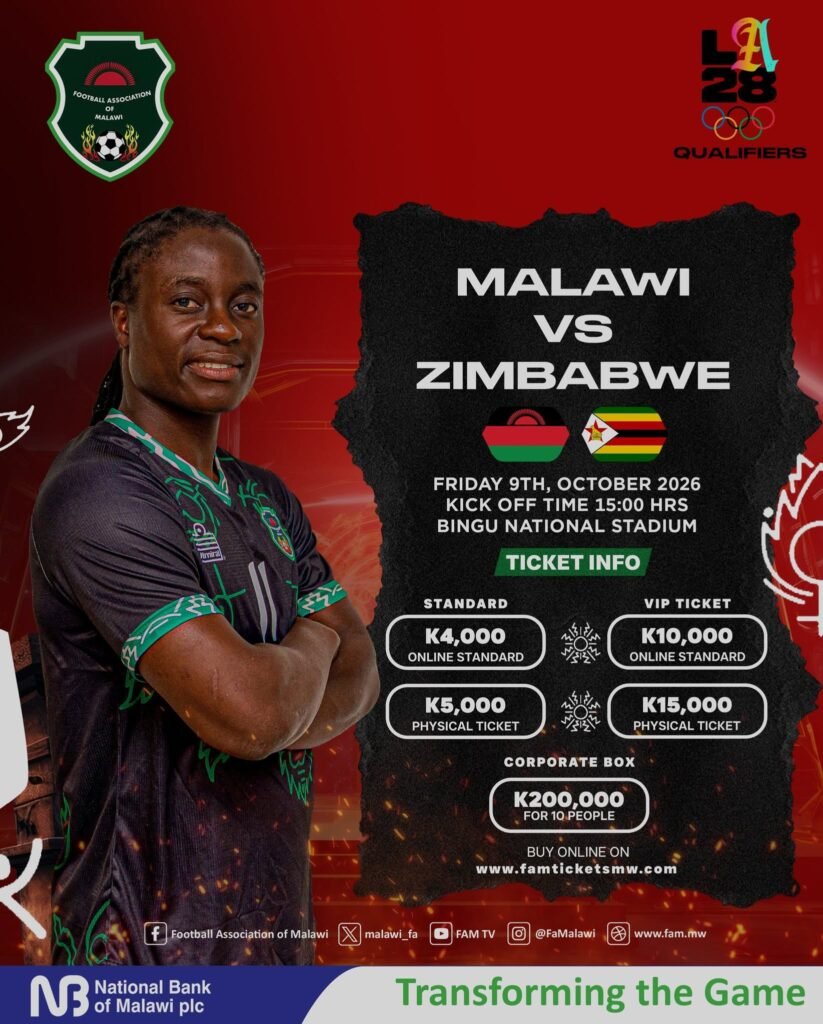
The pricing strategy is notable because FAM is offering a discount for digital purchase, which both encourages advance sales and gives the association clearer visibility into demand before match day.
For supporters, however, the logic is simpler.
This is the first home appearance of the Scorchers since their WAFCON silver-medal campaign.
The team left Malawi as challengers.
They return as continental finalists and World Cup qualifiers.
Friday is the first opportunity for a home crowd to receive them in that new status.
Why turnout matters commercially
Attendance is not merely a support metric.
It is market evidence.
For federations, sponsors and broadcasters, a growing women’s football property is easier to value when audience behaviour can be demonstrated.
Ticket sales tell a story.
So do digital purchases.
So does stadium occupancy.
So does merchandise demand.
So do livestream numbers.
So do social-media interactions before and after the match.
A large audience at Bingu National Stadium therefore has value beyond the atmosphere it creates on Friday afternoon.
It tells potential commercial partners that the Scorchers are capable of converting sporting success into consumer attention.
That is the beginning of sports business.
The stronger the evidence of demand, the easier it becomes to justify larger sponsorship packages, better media partnerships, more sophisticated merchandising, fan products and sustained investment in the women’s game.
There are signs the market is already moving
The days immediately preceding the Zimbabwe fixture have provided an early illustration.
Airtel Malawi this week rewarded Scorchers players and officials with 50 5G routers and a year of unlimited data following the WAFCON campaign. The company explicitly linked the gesture to the visibility and excitement generated by the team’s continental performance.
That is not yet the same thing as a fully mature commercial market around women’s football.
But it is evidence of something changing.
Corporate actors are recognising the team as a platform with public relevance.
The challenge now is to turn episodic recognition into recurring commercial value.
Zimbabwe understands the stakes too
That is also why their chartered flight matters.
At first glance, it is simply a travel decision.
At another level, it is evidence of intent.
Zimbabwe is spending resources to reduce fatigue, protect recovery time and give its players the best possible preparation for the fixture.
Elite sport is often decided at the margins.
The opponent arriving well-rested matters.
The home crowd matters.
The condition of the pitch matters.
The timing of foreign-based player arrivals matters.
The number of full training sessions matters.
The recovery window before the return fixture matters.
The story of Olympic qualification therefore begins long before kick-off.
What happens after Friday?
The Bingu National Stadium match is only the first half of the assignment.
Malawi must then travel to Harare for the second leg on 13 October.
The scores from both matches will determine which nation advances.
If Malawi progresses, the Scorchers will face the winner of Kenya versus Seychelles in February 2027.
Then the pathway becomes progressively narrower:
16 teams.
8 teams.
4 teams.
2 Olympic qualifiers.
The final two African teams will earn the right to take their places in a 16-team women’s Olympic football tournament spanning the United States and ending at the Rose Bowl in California.
That is what Friday ultimately points toward.
Not merely Zimbabwe.
Not merely another fixture.
Los Angeles.
From underdogs to an emerging sporting property
The most interesting question around this Scorchers team may no longer be whether Malawi can produce extraordinary individual performances.
It clearly can.
The more consequential question is whether Malawi can institutionalise success.
Can the national team qualify repeatedly?
Can the domestic system continue producing players?
Can foreign-based players strengthen rather than replace that system?
Can major home fixtures become reliable commercial events?
Can supporters become a measurable audience?
Can corporate interest become sustained sponsorship?
Can World Cup qualification lead to Olympic contention rather than represent the high-water mark of one generation?
That is the larger business story sitting behind this tie.
The WAFCON run gave Malawi attention.
The World Cup qualification gave it global relevance.
The Olympic campaign now offers an opportunity to compound both.
Thirty-five African nations entered.
Two will reach LA28.
Zimbabwe has come to Lilongwe prepared, rested and carrying recent evidence that it can win at Bingu National Stadium.
Malawi comes home with a continental silver medal, a deeper international squad, a growing domestic audience and an opportunity to prove that the fairytale has evolved into something more durable.
Friday afternoon is where the next test begins.
Reign on, Scorchers. 🇲🇼❤️🔥⚽️