

Malawi Win Group C — Even in Defeat
Why Tabitha Chaŵinga’s Goal Against Zambia Changed Everything
Football can be cruel.
It can also be very, very mathematical.
On 5 August 2026, Malawi lost 2–1 to Zambia in their final Group C match at the Women’s Africa Cup of Nations.
Zambia won the game.
Malawi won the group.
And Zambia went home.
To understand how, you have to understand both the football Malawi played that night and the strange geometry of Group C.
Because Tabitha Chaŵinga’s 72nd-minute goal did not equalise the match.
It did not win the match.
It did something more complicated.
It changed the mathematics of qualification.
For the first time, Malawi were chasing
Every tournament run eventually asks a team what happens when the game stops going its way.
Against Zambia, Malawi found out.
The Scorchers had opened their first-ever WAFCON campaign by beating defending champions Nigeria 3–2, then followed that result with a commanding 3–1 victory over Egypt.
Six points from six.
Six goals scored.
Then came Zambia.
Malawi were without Rose Alufandika, suspended after her red card against Egypt, forcing coach Lovemore Fazili to reorganise the defence.
Faith Chinzimu dropped into the back line alongside Chimwemwe Madise, Benadetta Mkandawire and Ireen Khumalo.
Madyina Nguluwe, Letticia Chinyamula and Sabinah Thom operated through midfield, with Rose Kadzere, Tabitha Chaŵinga and Temwa Chaŵinga carrying the attacking threat.
The disruption mattered almost immediately.
Two minutes: Barbra Banda
Malawi had barely settled.
Barbra Banda scored in the second minute.
Zambia 1–0 Malawi.
It was the earliest goal the Scorchers had conceded at the tournament.
For the first time at WAFCON, Malawi were behind.
Then, in the 37th minute, Prisca Chilufya doubled Zambia’s advantage.
2–0.
For the first time in Morocco, Malawi went into half-time trailing.
And because Nigeria were simultaneously playing Egypt, the problem was no longer simply the score in front of them.
It was the table.
Three teams were heading toward six points
Malawi entered the final round of Group C with six points after victories over Nigeria and Egypt.
Nigeria had three.
Zambia had three.
Egypt had none.
Nigeria went on to defeat Egypt 6–2.
That meant Malawi, Nigeria and Zambia would all finish the group stage on:
Six points.
Ordinarily, supporters might look immediately at overall goal difference.
But WAFCON’s tiebreak process first considers the matches played between the teams that are tied.
And that is where Group C became fascinating.
Malawi had beaten Nigeria.
Nigeria had beaten Zambia.
Zambia were now beating Malawi.
A perfect circle.
The three-way mini-table
The relevant results were:
Malawi 3–2 Nigeria
Nigeria 1–0 Zambia
Zambia 2–1 Malawi
Each side had one win and one defeat against the other two.
That meant:
Malawi — 3 head-to-head points
Nigeria — 3 head-to-head points
Zambia — 3 head-to-head points
Still tied.
The next separators therefore came from what happened inside those three matches.
And once the teams had effectively cancelled one another out on points, goals scored in the mini-table became decisive.
Malawi had scored:
3 against Nigeria + 1 against Zambia = 4
Nigeria had scored:
2 against Malawi + 1 against Zambia = 3
Zambia had scored:
0 against Nigeria + 2 against Malawi = 2
So the decisive attacking totals became:
Malawi — 4
Nigeria — 3
Zambia — 2
That is why one Malawi goal mattered so much.
At 2–0, the picture had changed
At half-time, Malawi were not simply losing a football match.
Their position in the group had become precarious.
They did not necessarily need to win.
They did not even necessarily need an equaliser.
They needed to score.
One goal.
That was the assignment.
And that distinction matters.
Tournament football sometimes asks a team to understand something more complicated than, Can we win this match?
The real question becomes:
What exactly do we need from this match to survive?
Malawi needed one.
The underlying football told a different story
Despite being two goals down, Malawi had not been overwhelmed.
Zambia finished with approximately 54.8% possession to Malawi’s 45.2%.
But the Scorchers actually attempted more shots.
Malawi 11. Zambia 10.
More strikingly:
Malawi 5 shots on target. Zambia 3.
That is an unusual statistical profile for a losing side.
Malawi had not been suffocated.
They had been punished.
There is a difference.
The game was also considerably more physical than Malawi’s first two matches.
The Scorchers committed 16 fouls and received four yellow cards.
They won 62 duels.
Tabitha herself won 11 duels, the most of any player in the match, while Rose Kadzere won six aerial contests.
The match had become a fight.
Malawi stayed in it.
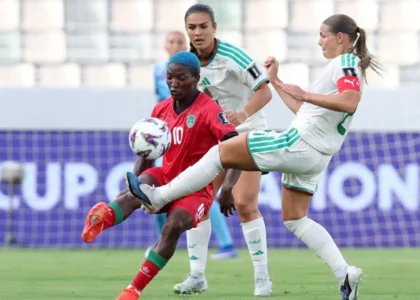
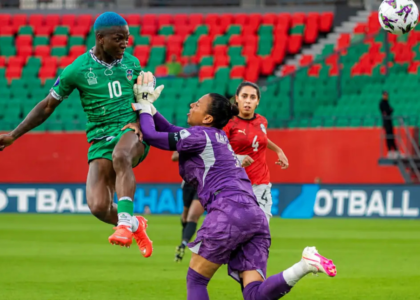
72 minutes: the captain
Then came the 72nd minute.
Tabitha Chaŵinga.
She moved beyond two defenders and drove a low finish past the goalkeeper.
Zambia 2–1 Malawi.
On the scoreboard, the Scorchers were still losing.
In the qualification picture, they had just transformed their night.
That is what makes the goal so unusual.
It did not produce parity.
It produced position.
It did not make the score 2–2.
It made Malawi’s head-to-head attacking record stronger than both Nigeria’s and Zambia’s.
At 2–0, Malawi were in serious danger.
At 2–1, they had what they needed.
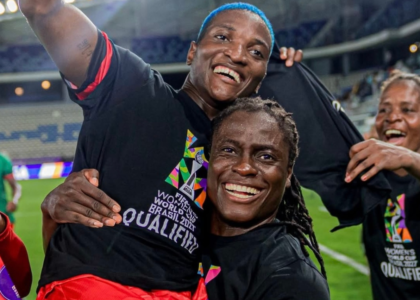
The captain had scored Malawi back to the top of Group C.
Zambia knew another goal mattered
The final minutes were therefore not a routine attempt by Zambia to protect a victory.
The Copper Queens had every reason to keep attacking.
Another goal could change the qualification picture again.
That made the closing stages increasingly tense.
Kabange Mupopo came painfully close.
Her late effort struck the woodwork.
For Zambia, a third goal might have changed everything.
For Malawi, every defensive action now carried the weight of qualification.
The Scorchers did not find an equaliser.
They did not need one.
They simply could not concede again.
The final whistle came.
Zambia 2. Malawi 1.
Then attention shifted to the table.
Zambia won the match — and left the tournament
Nigeria completed its 6–2 victory over Egypt.
The final Group C points were:
Malawi — 6
Nigeria — 6
Zambia — 6
Egypt — 0
Three teams.
Six points each.
But the head-to-head mini-table separated them.
Malawi had beaten Nigeria.
Nigeria had beaten Zambia.
Zambia had beaten Malawi.
Each had one victory and one defeat.
Then came the goals.
Malawi had scored the most.
The final order placed Malawi first in Group C, Nigeria second and Zambia outside the qualification places.
Zambia had beaten Malawi on the night.
But Zambia were eliminated.
Malawi had lost.
But Malawi were group winners.
Why Tabitha’s goal was bigger than a consolation
Football language often describes a late goal in a defeat as a consolation.
This was anything but.
There are goals that win matches.
There are goals that win trophies.
And then there are goals whose importance only becomes visible when you understand the table.
Tabitha’s strike against Zambia belongs in that third category.
At 2–0 down, Malawi’s position was dangerous.
At 2–1, the Scorchers were back where they needed to be.
One goal meant Malawi could lose the game and still win the group.
That is exactly what happened.
And there was another layer to it.
Tabitha did not simply score.
She had spent the match fighting through a physical contest, winning more duels than any other player on the pitch.
Then, when Malawi needed one decisive attacking moment, the captain produced it.
Losing also revealed something about Malawi
The Zambia match became the Scorchers’ first defeat at WAFCON.
But it also exposed characteristics that would matter enormously in the knockout stage.
Malawi could concede early and stay alive.
They could lose defensive personnel and adjust.
They could create more shots than a strong opponent even while trailing.
They could take punishment without disappearing from the match.
They could understand the game state.
And they could produce the exact goal they needed.
The defeat showed that Malawi were vulnerable.
They could be punished.
Their defensive structure could be disrupted.
Their attacking talent could not erase every mistake.
But it also showed that they could remain dangerous while the match was going wrong.
That distinction would become vital.
From debutants to Group C winners
Three matches earlier, Malawi had never played a minute of WAFCON football.
Now look at the group they had just won.
Nigeria — defending African champions.
Zambia — one of southern Africa’s strongest women’s teams.
Egypt.
And above all three:
Malawi.
The Scorchers had beaten Nigeria.
They had beaten Egypt.
They had lost to Zambia.
And somehow, they still finished first.
Not through luck.
Not through a mysterious administrative decision.
Through the very goals they had scored against the teams around them.
And especially through one goal in the 72nd minute against Zambia.
Tournament football is about knowing what you need
League football rewards accumulation.
Tournament football rewards survival.
Sometimes surviving means winning.
Sometimes it means defending.
Sometimes it means understanding that a 2–1 defeat can be more valuable than a 2–0 defeat.
At half-time, Malawi did not need panic.
They needed precision.
One goal.
Tabitha delivered it.
And because she did, Malawi advanced to the quarter-finals as winners of Group C.
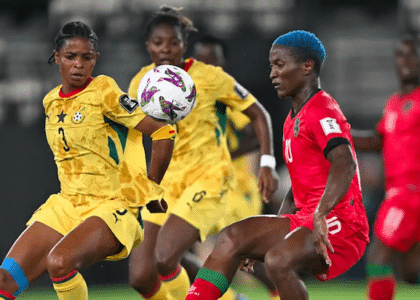
The next match would be against Ghana.
And this time, there would be no complicated mini-table waiting at the final whistle.
The equation would be much simpler.
Win — and Malawi would go to the FIFA Women’s World Cup.
The Scorchers had survived the mathematics of the group.
Now they were going to play for history.
Match Snapshot
Malawi 1–2 Zambia
2’ — Barbra Banda
37’ — Prisca Chilufya
72’ — Tabitha Chaŵinga
Possession: Malawi 45.2% | Zambia 54.8%
Shots: Malawi 11 | Zambia 10
Shots on target: Malawi 5 | Zambia 3
Malawi fouls: 16
Malawi yellow cards: 4
Malawi Starting XI
Mercy Sikelo
Faith Chinzimu — Chimwemwe Madise — Benadetta Mkandawire — Ireen Khumalo
Madyina Nguluwe — Letticia Chinyamula — Sabinah Thom
Rose Kadzere
Tabitha Chaŵinga
Temwa Chaŵinga
Used from the bench
Asimenye Simwaka replaced Sabinah Thom.
Tendai Sani replaced Madyina Nguluwe.
Vitumbiko Mkandawire later replaced Sani.
Group C Final Picture
Malawi — 6 points — Group Winners
Nigeria — 6 points — Qualified
Zambia — 6 points — Eliminated
Egypt — 0 points — Eliminated
Zambia won the match. Malawi won the group.
And one goal made the difference.