
The Night Malawi Announced Itself
There are difficult introductions to tournament football.
And then there is being handed Nigeria.
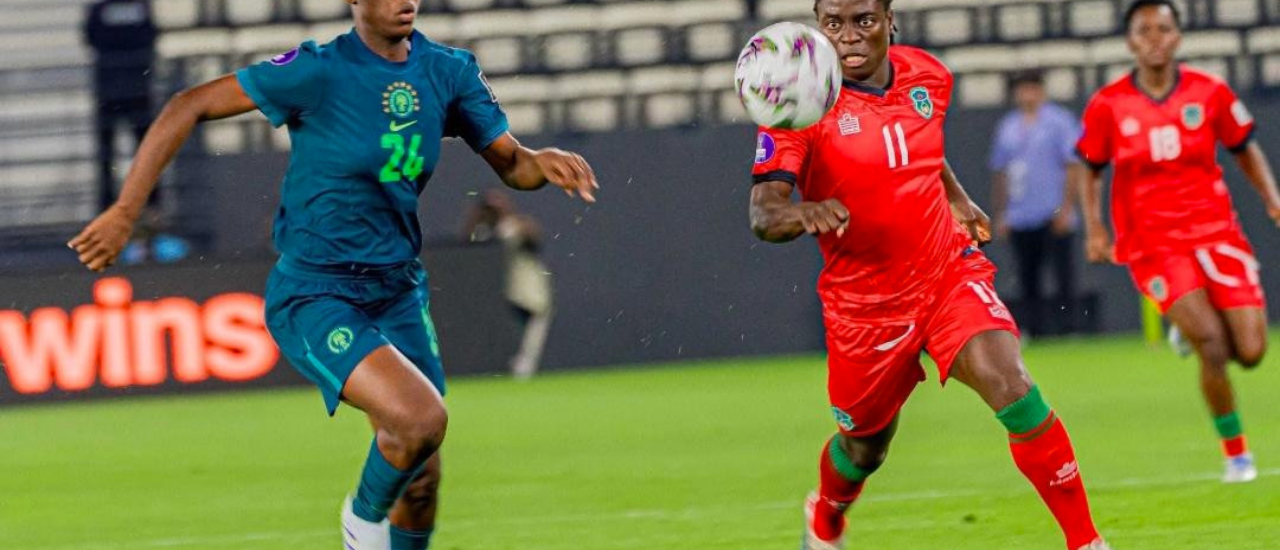
On 28 July 2026, Malawi walked onto a Women’s Africa Cup of Nations pitch for the first time in the country’s history. Across from them stood the defending champions, the most successful nation in African women’s football and ten-time continental winners.
The Scorchers were not expected to win.
For much of the match, it looked as though Malawi might simply be pleased with proving they belonged.
Then came the 73rd minute.
And everything changed.
Seventy-two minutes of patience
Malawi began in a 4-2-3-1, with Mercy Sikelo in goal behind a back four of Rose Alufandika, Chimwemwe Madise, Benadetta Mkandawire and Ireen Khumalo.
Madyina Nguluwe and Letticia Chinyamula anchored midfield, while Rose Kabzere, Faith Chinzimu and captain Tabitha Chaŵinga operated behind Temwa Chaŵinga.
The structure told part of the story.
Malawi did not arrive intending to place nine players behind the ball and hope.
Nigeria had more possession, but not overwhelmingly so: approximately 54.7% to Malawi’s 45.3%. More remarkably, the teams finished level on 13 shots each. Malawi had seven attempts on target, Nigeria eight, while Malawi actually won the corner count 5–4.
Those numbers matter because they immediately challenge the simplest interpretation of the result.
This was an upset.
It was not a smash-and-grab.
Malawi competed.
Temwa writes Malawi’s first WAFCON line
The breakthrough arrived in the 73rd minute.
Temwa Chaŵinga.
Malawi’s first goal at a Women’s Africa Cup of Nations belonged to one of the greatest players the country has ever produced.
Six minutes later, the story became a family affair.
Tabitha Chaŵinga.
2–0.
The elder sister who had spent more than a decade building a professional career across Sweden, China, Italy and France had now scored on the continental stage for Malawi.
Nigeria responded late.
Rasheedat Ajibade converted a penalty in stoppage time and suddenly the champions had a path back into the match.
But instead of collapsing, Malawi attacked again.
At 90+5, Temwa scored her second.
3–1.
Uchenna Kanu added another for Nigeria deep into stoppage time, but there was no time left to undo what Malawi had done.
Nigeria 2. Malawi 3.
Mercy Sikelo’s six saves
Three goals naturally dominate the memory of a 3–2 win.
But the result also required Mercy Sikelo.
Nigeria put eight shots on target. Sikelo saved six of them.
At the other end, Temwa attempted seven shots herself, putting four on target and scoring twice.
That combination — an explosive transition attack at one end and a goalkeeper capable of surviving pressure at the other — would become one of the defining features of Malawi’s tournament.
The Scorchers did not need to own the ball.
They needed to make their possession dangerous.
The bench mattered too
Sabinah Thom replaced Madyina Nguluwe in the 50th minute as Malawi adjusted the midfield battle.
Vanessa Chikupila came on for Kabzere in stoppage time as Malawi attempted to manage the final moments.
The result was historic by almost every measure.
But perhaps its greatest consequence was psychological.
Malawi had arrived at WAFCON as debutants.
They left their first match knowing that the word debutant did not have to mean inferior.
Nigeria had entered the competition as champions.
Malawi had beaten them on the pitch.
The rest of Africa now had evidence.
The Scorchers were not in Morocco simply to participate.
They were there to compete.
Match Snapshot
Nigeria 2–3 Malawi
Temwa Chaŵinga 73’, 90+5’
Tabitha Chaŵinga 79’
Possession: Nigeria 54.7% | Malawi 45.3%
Shots: 13–13
Shots on target: Nigeria 8 | Malawi 7
Corners: Nigeria 4 | Malawi 5
Mercy Sikelo saves: 6
Malawi starting XI: Mercy Sikelo; Rose Alufandika, Chimwemwe Madise, Benadetta Mkandawire, Ireen Khumalo; Madyina Nguluwe, Letticia Chinyamula; Rose Kabzere, Faith Chinzimu, Tabitha Chaŵinga; Temwa Chaŵinga.